
Dane Davis
Home was a Superfortress
He had never allowed himself to think too deeply about the war. About his part in it.
For sixty years he didn’t think about it. Buried it. Told himself simply that it’s what we had to do to win. And for most of his life, he slept like a baby. There were moments when he worried, was he a good man? Would he make it to heaven? Sometimes, his own existence frightened him. The fact that he was still alive while others weren’t. The death of others had been crossing his mind almost daily, as his own death crept closer.
As a young man, he bombed Japan for a year straight. He bombed Honshu and Shikoku and he bombed Okinawa. He bombed Formosa. He bombed Tokyo and Yokohama and Kobe. He bombed Osaka three times in a month.
He bombed at night and he bombed in the day. He bombed from twenty-five-thousand feet high, and from five thousand feet low. But always from afar. He bombed strategically, always precise and accurate. A lot of the runs were firebombs, blanket and incendiary.
He bombed wired and anxiously. He bombed bored and tired. He bombed in fear and he bombed in laughter. He bombed aloof, thinking of trivial abstractions. He bombed deathly focused as flak burst all around his plane, sweat dripping down his viewfinder.
He dropped his payload and would be home in time for supper. There was no reverence among his crew. Gone were the shakes and sweats of the first few missions, the double- and triple-checking safeties, coordinates, order clearances, thoughts of men in his unit who hadn’t made it back for supper. But now, just another day, another city to fly over, and only a verification of targets. No regrets in wartime. Before and after their run, the crew talked pin-ups. Ava Gardner and Jane Russell and Betty Grable. They talked baseball. The Cubbies were going all the way to the world series.
He would look through the viewfinder crosshairs, push the button and let the bombs go. He did this every week for a year. His bomber took off from Guam and Saipan. Fifteen-hundred miles later he’d be over Fukuoka or Chiba or Nagoya. He pushed a button and released thousands of pounds of explosives and incendiaries and then flew back. Some nights he fell asleep to the engine’s hum.
He bombed manufacturing plants and factories. He bombed airfields and railway stations. He bombed schools and hospitals. He levelled a million homes. His bomber was one of several hundred, flying night and day in sorties of two and three hundred B-29s at a time. Destroying over a hundred square miles of urban spaces. Levelling more areas than all the bombing over Germany. Bombing Kobe so effectively it was crossed off the target list as not worth revisiting.
Through the viewfinder he would look at a still world through haze-cloud. Life imperceptible from such an altitude. He pushed the button and watched the payload fall. And several seconds later, he watched the bursts of earth like small blotches of speck-dust, as the bombs made contact. Small and seemingly harmless from thirty-thousand feet. Too distant to ever fully realise their true force.
Sometimes, the plane moved away so quickly he didn’t even see the impacts, didn’t hear the explosions over the thrum of the engines. And at night, he would push the button and watch through the crosshairs, tiny flicks of light shining as the target would be baptised in flames and erased before sunrise.
He firebombed a hundred Japanese cities. Ninety-nine percent of Toyama was levelled. He could feel the heat of the conflagration when he bombed Tokyo, where he dropped five-hundred-pound clusters of incendiary napalm bomblets. He felt his face sear, in the greenhouse cockpit, making him sweat profusely and feel dizzy. He couldn’t put his hand on the glass panel of the nose cone, the heat was so intense.
He dropped magnesium bombs and thermite and white phosphorus bombs. A thousand-year-old city of bamboo and wood, a paper city, incinerated over the course of a night. Flames so hot they melted steel. Airmen threw up in their planes at the smell of burning flesh. Sometimes, the heat of the fires created its own weather system, a firestorm, with its own sustained winds feeding the inferno.
Brass in the XXI bomber command pleased as punch. LeMay’s masterpiece ‘Bombs away’. Sixteen-hundred tons of explosives were dropped on Tokyo in a single night. Sixteen square miles of the city burned to the ground.
He knew the boys from the Enola Gay. Thought they were great guys. Couldn’t understand the logic of dropping a single bomb. What would that do? Hiroshima reduced to nothing. Then Nagasaki. Then it was over. Japan surrendered. Submitting under the weight of catastrophic destruction. Succumbing to the pressure of a hundred levelled cities. Capitulating to a decimated infrastructure. Yielding to the heft of American bombs, unrelenting and vast in prolongation. Stern and unsympathetic in their bombing campaign’s undeterred conviction.
After the surrender, he was released from duty. Honourable discharge. No more flak or viewfinders. No more fifteen-hundred-mile journeys over the Pacific through turbulence. No more thin, air at thirty-thousand feet. No more faint pounding like distant kettledrums as arsenals of pure force and appalling power slammed into targets and levelled them.
He moved home to Springfield, Missouri. Got a job in a factory, on the assembly line to infinity. Dead-end job in a dead-end factory in a dead-end town. The union promised him a pension and a cheap gold watch for twenty years of work.
And on Friday nights, suds and liquor to dull the monotony. He married a girl he went to high school with and wasn’t interested in at the time, but he was getting on and she was nice. Comfortable mortgage that would be paid off just before retirement. He thought about happiness and considered how rudimentary the word was for such a prime emotion. An expressive emotion. His life was good. Comfortable. Secure. So normal feeling that he didn’t complain when age crept up on him, made him fat and slow.
Twenty years and a brand new war later. He watched this one on TV at home, at dinner time, and felt as removed from it as the one he had fought in. Eighty-eight hundred miles was no further away than thirty-thousand feet.
Napalm-burned children broadcast into fifty million homes for everyone to see. This war was real, unfiltered and raw. It upset people. Made them angry and disgusted. Not proud or patriotic. He had dropped fire on innocent people every night for a year, in his war. He caused just as much destruction and bloodshed in his war. But he was considered a hero. His war was just.
He got older still. Worked his way into a management position at the factory. Forty years and a plaque with his name on it. The kids grew up and went to good colleges and got good jobs. He celebrated wedding anniversaries as they came and went. Took on gardening as a hobby. Felt good with the dirt and soil in the cracks of his hands and under his nails. In summertime, out in his garden, he would look up and watch the vapor trials of airline jets at thirty-thousand feet stream through the baby blue sky. He enjoyed retirement.
He started having nightmares. Ashen landscapes and winds of fire blowing hot through charred city streets. All around him as he walked, the tar-black corpses of the dead. Piled in their hundreds. Still smouldering as their outer skin burned and melted. He woke up screaming, in a deluge of sweat. Every single time. He had a nightmare at least once a week. His doctor gave him sleeping pills to get over them. He laughed off the suggestion of therapy. His wife started sleeping in the guest room.
He got older. His twilight years. Too old to garden. Too old to maintain the house. His wife passed. The kids started with kids and mortgages of their own. He sold the house and joined a retirement village, at the prodding of his kids. God’s waiting room.
Death on the horizon. He began reflecting. His life. His legacy. He had been a good man. He had done everything right. Career, marriage, kids, mortgage. It had been easy. It had been safe. It had been stable. He hadn’t taken unnecessary risks. He had served his country and came home and served his community as a civilian.
His life had been more than the year he spent over Japan. But somehow the rest never quite compared; nothing so significant as his life in the bubble of a bomber had ever happened to him again.
His legs gave out. He was put in a wheelchair. Made to sit and wait to die, thinking back on all his life. The highs and the lows and everything blurred into one banal stream of existence.
He had terror-bombed a nation. His war was vastly more destructive than that of the boots on the ground. His killing was indiscriminate, indeterminate, arbitrary. He had been so removed from the circumstance and the physical reality of a battlefield, he could never answer the question, just how many people had he killed? He flew at thirty-thousand feet. High enough to fly above the consequences of a war. High enough to fly above the consequences of his actions, he thought. Looking through an oculus at the grey canvas of city and pushing a button meant never having to experience what happened beneath the impact. Meant never having to ask about the details.
He would never know the fear of his city being bombed. He would never know the terror of a bomb falling on him. He would never know the heat of those huge globs of fire as they consumed the landscape.
He had bombed Japan for a year. He bombed Japan day and night. He destroyed the country and thought nothing of it. Felt nothing of it. He died on a Tuesday. Living out his peaceful, boring life to the end. He died lucid, but in an aloof and addled reflexion of blurry, unknowable consequences of the part he played in war.
“After seeing an old USAF photo of B-29s dropping incendiary bombs over landing piers in Kobe, Japan, I became intrigued by the idea of a war being fought from thirty thousand feet, and the removal of an immediate trauma that might be faced, from fighting on the ground. Of a life spent never fully coming to terms with the actions committed in a war, by virtue of evading the consequences of those actions. The unseen never being contemplated and thus, never able to grieve.” —Dane Davis
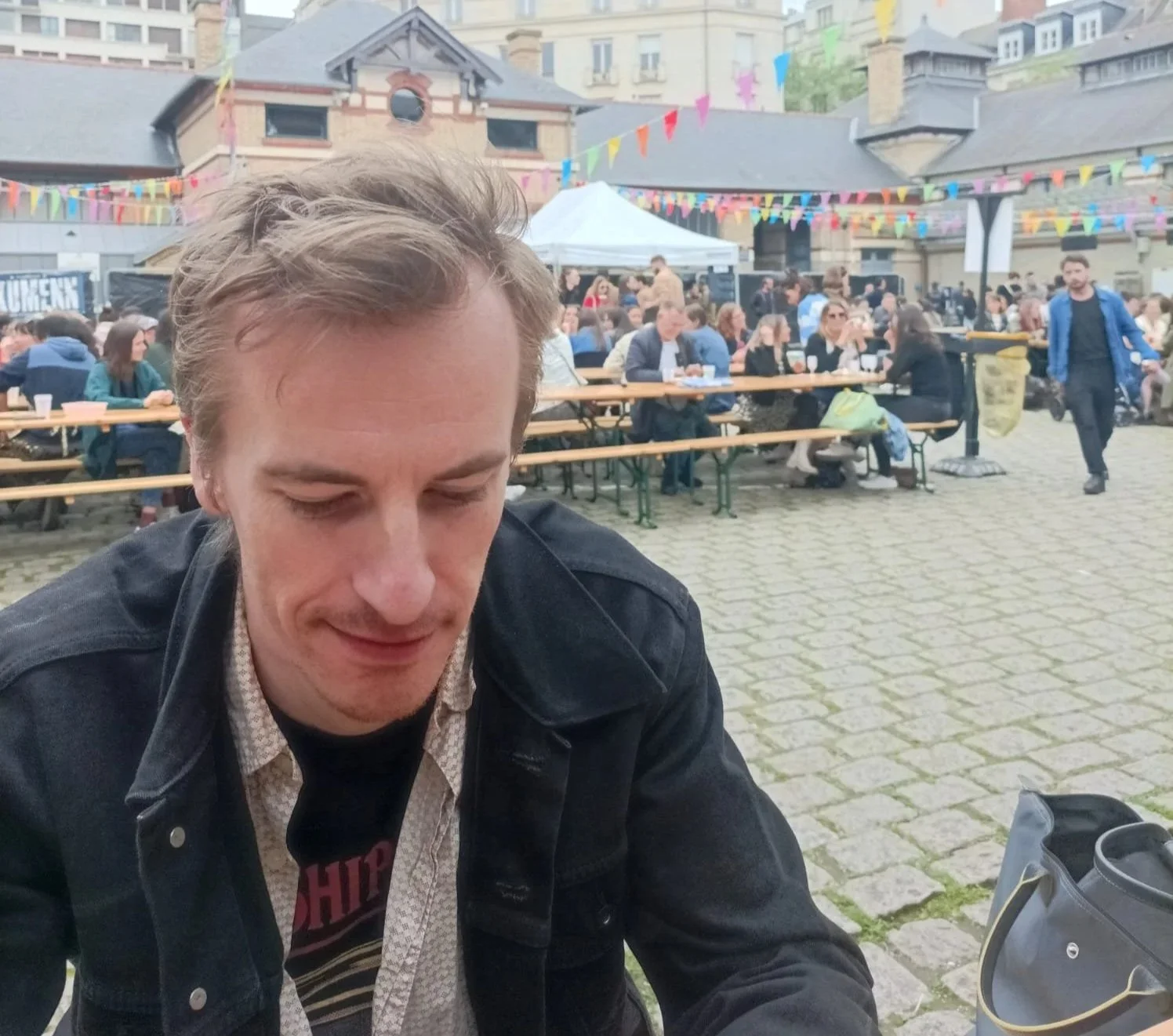
Dane Davis was born in Dublin, Ireland. After living in New York and London, he now resides in France with his partner Hélène and his cats Bernie and Baku. He has Partaken in writing workshops with City University, London and BFEI, Dublin. He has previously been published in Bristol Noir.
