
Ankush Banerjee
Hero
“Cancer, stage four,” Dr. Kumar said.
The doctor looked straight at the patient, who sat at the edge of the metallic examination table, legs dangling, fiddling with his sunglasses.
“Cancer,” the patient, who was not yet a patient, repeated, not knowing what else to say. Manik, who suddenly felt very much like a patient, felt he had to physically swallow the words to absorb their meaning.
For the past month, he had been pissing urine thickened with blood. A sharp ache had gnawed at his abdomen. He’d had scans done just the day before. He now sat in front of Dr. Kumar, who, it was apparent to Manik, was making an effort to be kind. Instinctively, he had wanted to thank Dr. Kumar for his kindness, his promptness.
Manik was dressed for golf. Blue polo shirt and chinos. After golf, he had an appointment at the local TV studio for an interview. His blazer was kept in his car. Some of the studios still called him to feature on their televised debates. Below his name on the on-screen ticker, the phrase Defence Expert informed the world who he now was. Even after so many years, the word expert mildly rankled him, as if he was dressed in clothes too large or too small. After his premature retirement from the Army, when the TV channels had first invited him, he had been nervous.
“But what do I have to say about China’s geopolitical position?” he had asked Shobha, his wife, while flipping through a fat book on China. There was a pile of them on the table, sitting imposingly next to a smaller bunch of poetry books. “I am no expert,” he said, making quotation marks with fingers while uttering the word.
“It doesn’t matter what you say,” she said sharply, almost dismissively, while she ironed his good grey shirt, hanging a matching cravat, in preparation for the interview. “You came back alive from enemy territory. You are a war hero to them.”
Even before he appeared on TV, Shobha knew he had a face for the cameras. For one, he was tall and fair. He had a sharp jaw line and a deep baritone. She’d said more than once that his salt and pepper stubble and gold-rimmed spectacles made him look intelligent and learned. Age had done to his face what it did to monuments, lending it an aura of quaintness. On TV, he spoke slowly, deliberately, finishing his sentences with the finality of someone who is sure.
But was he sure?
This one time, a TV channel had offered him an undisclosed amount of money for criticising the government’s latest policy. He knew the policy deserved to be criticised. But he had refused the money and forbade the channel from calling him again. He had been so offended at the audacity of the TV channel that he hadn’t switched on the TV for days. The incident had gone around media circles, earning him a reputation. Shobha had been touched and amused at his prickly self-righteousness.
On TV, his positions were never extreme, unlike those of the other veterans. He read extensively, thought deeply, and rehearsed his points meticulously. He liked being prepared. During debates, he frequently complimented other participants, especially those with views opposing his own. At times, the show’s host had to ask him not to be so polite.
Once, discussing Kashmir, he had quoted a line from Faiz. This had deflated the debate’s charged atmosphere, unexpectedly bumping up the TRPs. The clip of Manik quoting Faiz went viral, earning him the hashtag #SoldierPoet on Twitter. For three months, no one called him to their shows. Long enough for him to think his moment of fame was spent. But then the invitations started pouring in again.
“People have short memories,” Shobha had said, laying the dinner table.
“Yes! They have forgotten the war,” he had said, preparing his lecture notes.
During this hiatus from TV, a couple of private universities had invited him to deliver guest lectures on leadership. He had to read up on Christensen and Kotter, Lewin and Porter. These, too, sat beside unread poetry books; he only sifted them before sleeping. He enjoyed lecturing. It was better than appearing on TV. One wasn’t caged beneath the invisible pressure of pumping TRPs. One wasn’t speaking to a black box. During lectures, he could see, interact with, and speak to his students. He could sense the class’s boredom, or the youthful wonder running like electricity when he recounted a vivid anecdote from the detritus of his past life.
He liked being prepared, as he was prepared to die on the starless night his platoon had been discovered by the enemy. The enemy platoon’s warning to surrender had been sure and ominous. On his orders, his team had fired back. One of his men had died in the skirmish. Manik had been shot in the right leg, the bullet shattering his shinbone. He, along with three of his men, had been captured. The raging gunfight had given them enough time to relay bad news to the Base Commander.
This had happened long ago, during another bitter but short war fought over a border issue that had remained unresolved for the last sixty years. No, it wasn’t a war, or not the kind of war happening in Ukraine, or the Middle East. The war that wasn’t a war had started with a terror attack, a provocation served in the guise of alternate narratives and pointless civilian deaths.
Before the war, Manik had been prepared for many things. But he hadn’t been prepared to be taken prisoner. Who is? He had been married just a month before the conflict started. The enemy bandaged his leg and carried him to the enemy base camp. From there, in a rickety military truck, through jungle and rain, he was taken to the local military hospital, where the offending bullet was removed by an Army doctor who looked too shabby to be in the Army, and too young to be a doctor. Manik and his three men were ‘assets’ to be used to broker peace in the negotiations. They knew they’d be kept safe, which is to say, they knew they’d be kept alive, at least for a time. The threat of violence lurked whenever they were taken to the dimly lit interrogation rooms.
He remembered this time vividly, saturated with the feeling of teetering on the edge. He learned later, after he returned, that Shobha hadn’t slept that week. She had stopped eating. She hadn’t switched on the TV. All of the news coverage was splashed with photos of him and his men. The press had discovered childhood photographs, growing-up photographs, wedding photographs. The barrage of news coverage of their personal lives had been relentless. The press reserved special sympathy for Manik, given that he had recently been married. Shobha found the press’s constant iteration of their “newly married” status annoying, obscene, even absurd.
Then the conflict stopped as abruptly as it had begun. He had grown a stubble and lost weight. His leg had been bandaged with thick gauze, resembling the trunk of an old tree. By the time they were released as part of hurried negotiations, in which both sides claimed to have triumphed, everyone knew the group of prisoners, with an awareness as unsettling as it was infectious. They celebrated his return as that of a long-lost hero to his people. A TV channel showed him emerging from the airport in a wheelchair, an emotionally charged Bollywood number playing in the background. The wound had somewhat healed, but Manik learned that he’d need a rod or a prosthetic attachment where his shin had been. More than feeling like a hero, he was relieved to be returning alive. From inside the noisy military aircraft flying to the Capital, he had looked at the barren, snow-covered landscape passing below, and uttered to himself the word life, with a delicate flourish, as if it were a lozenge he was intent on holding in his mouth.
Life, he wanted to say with the same delicate flourish, part philosophically, part ironically, while he sat in front of Dr. Kumar. But the word didn’t come to him. Not the philosophy, not the irony, not the word. The starch on the back of his Polo shirt was congealed with sweat. His Smartwatch informed him that his heart was still beating at 58 beats per minute. Was he nervous, anxious? He dug at his cuticles. He realised he wasn’t prepared for this.
“I will take another appointment, Doctor,” he said abruptly, politely. He did not look Dr. Kumar in the eye while shaking his hand. After he left, Dr. Kumar saw Manik had forgotten his sunglasses on the table.
*
Had Manik been troubled by the news, it didn’t show during the game of golf. He measured his lines and ambled around the course, trying to enjoy the things that had made him pick the game. The lush green expanse of the course, the manicured stillness, the gentle birdsong. Things which, he later realised, helped him think clearly. After years of playing football and basketball, experimenting with golf had been a letdown. With its tedious, monotonous rigmarole of putting one single ball into one single hole over a course of four hours, there was very little in it to keep him interested. But where there once was frustration at the pedestrian pace of the game, there eventually came a recognition of calm amidst the grass and birds. He’d finally felt the space he needed to process his new state of being, his physical handicap, impending retirement, and eventual transition to civilian life.
He had picked up golf because the doctors had strongly recommended it, given ‘his condition’, they said, pointing to the place where he now had a rod instead of a shinbone.
He rummaged for his sunglasses in his golf bag. Realising he wasn’t carrying them, he sent Ramanuj, the caddy, to the car. But when he returned empty-handed, Manik remembered leaving them at the Doctor’s. He felt a mild irritation, the sun’s glare pinching his eyes at the 6th hole. His caddy handed him a cap with a longer hood. His face’s shadow looked like a bird with an abnormally long beak, he thought, putting it on. He wanted to be amused by the idea, but could not bring himself to it.
*
Though Manik had returned alive, there were things that bothered him and Shobha—keeping a count of black trunks, transfers, moving and setting up new homes every few years, dealing with living apart for months, and worst of all, that edgy uncertainty that blanketed them when he was posted to Forward Areas.
What he could not tell Shobha at first was how he’d been glad to be relegated to a quotidian desk job for his disability. Eventually, one night, engulfed in the post-coital vulnerability of people who have grown comfortable with each other’s bodies, he had confessed to her, “Never told this to anyone: I have eleven kills, but I don’t like the killing. I wish I were doing something else.” He said this in a flurry, like someone who wasn’t used to articulating his feelings.
“Something else?” she had asked.
“I just don’t like doing this,” he had said.
“But you’re doing so well,” she had said. “Do you want to leave?” she had asked, peering into his glazed, glassy eyes.
At the time, he couldn’t answer her. He only kept doing what he was good at, or felt comfortable with: his job at the desk, in an institution that treated him like a hero. Though her question had opened a chasm in him that reopened periodically over the following years. It resurfaced in unpredictable moments, surging hotly through his chest, and making him catch his breath.
Curiously, Manik seemed to be rewarded for his ambivalence. A plum assignment, a good posting, another award or recognition. Shobha spotted the irony in the pattern and pointed it out to him over tea. He laughed at first, and then turned sullen, digging furiously at his cuticles. Shobha began treading cautiously through these conversations.
Their son, Shobhit, had turned eight. Shobha was looking forward to joining the local school as a teacher, restarting a career that had ceased after their marriage. Manik’s confessions of unhappiness began appearing more frequently now. An ordinary unhappiness that seemed mildly ugly, even obscene, when brought into the light of a good, strong marriage like theirs. His self-pity had started to seem selfish, too. Unfair. But he allowed himself to feel it, breathed through it, and continued doing what he did.
Over the years, Shobha settled into teaching, first as an assistant, then opening her own school with a small group of local children as her first students. Manik watched her focus on the children, saw her confidence blossom as she settled into her new calling. He could also see the concern nudge her eyebrows, the moments when her bright eyes turned a little nervous as they passed over him. Was it his unhappiness that worried her most, or something else that she wasn’t saying? He could sense that she saw through his disaffection, his rants, his quiet frustrations.
At times, she felt distant from him, treating him like an irate, persistent house guest who had overstayed his welcome. So she did the work of listening and supporting, making tea or mutton, depending on the intensity and the severity of his rants.
A few years before he finally gathered the courage to quit, he offhandedly remarked to her, “You know, we joined at seventeen, right after school. Someday, I hope I get to experience another life.”
“Then why don’t you!?” she had snapped at him, fleeing the room. He stood there, as shocked by her sudden anger as she was.
*
Manik took another shot at the 6th hole. He had to squint, as the sun was right ahead, pinching his eyes. “Don’t think I’ll be able to finish this today,” he told Ramanuj, the caddy.
Ramanuj, tall and wiry, had what Manik called a nervous disposition. Ramanuj resembled a tree ominously awaiting the passing of a storm. “Sir, wait five minutes, the sun will go below trees,” he said.
“I got cancer, Ram, stage four,” he said without looking at him, without irony. “Five minutes won’t cut it.” He didn’t care to spot how Ram’s face contorted. Instead, he took a sharp tap at the tee, which made barest contact with the ball. Ramanuj followed the ball as it rolled a few feet away.
*
Shobha was grading assignments when he returned from the studio. “Dinner is on the table,” she said, not looking up from answer sheets spread around her like reddened carcasses.
She had turned the front rooms of their home into a makeshift classroom. She made the children sit around the kitchen table, using a whiteboard behind her. The whiteboard still had equations scribbled on it. Their home had the quietness of seashells in the evenings, after Shobha’s rambunctious lot of tuition students left.
After Shobhit had gone off to Boarding School, their days came with the unostentatious intimacy of routine. Manik knew Shobha had a few cream crackers she liked nibbling while checking answer sheets. Shobha knew he’d take a bath, fix a drink, and sit on the balcony for a while before taking his dinner. She would get up around ten to make herself a cup of tea. If his dinner lay untouched, she’d scoff, heat it up, and place it beside him, grumbling something about men, then return to her answer sheets.
Tonight, though, he was drawn out of his routine. He moved smoothly to the wall full of framed photographs. Some from before they had met, most from after. Photographs of his younger self at his commissioning ceremony thirty years ago, or while he was being wheeled out of the airport, the frame beside it holding a newspaper clipping, announcing to the world, “National Hero Returns.”
Such things decorated their home, in addition to Shobha’s certificates, and small knick-knacks—a brass vase, a Dancing Girl showpiece, a Laughing Buddha—flotsam quietly accumulated on the shores of their marriage. He noticed how a fine line of rust had crept into the crevices of the medals, the glass pane housing them stained with little blotches of dust. He wanted to feel something, wistful, sad, angry, satisfied? Anything. But all he felt, looking at himself sitting atop a tank somewhere in the desert, chugging a beer without a shirt on, left hand flashing a V sign at the camera, was an emptiness he could not name.
“Shobha,” he said, from across the room, “I forgot my sunglasses at the Doctor’s office.”
She looked up, “You went to the Doctor?” And saw him searching her face, his hands hanging limp at his sides, his eyes glazed with the emptiness that was always there when he recounted stories of his kills.
“There are many things I wanted to explore and understand through this story. First, given the manifold increase in the spectacle quotient of conflicts today, with mass internet and media proliferation, I wanted to explore the implications of conflict as spectacle for the lives of those involved. Second, while conflicts affect people differently, time is a crucial factor that shapes how they affect ordinary lives. I wanted to stretch that time span long enough, really long enough, to see how the residual effects and affects of having lived through a conflict manifest in and shape the lives of people. Third, I wanted to explore how the politics and poetics of heroism can (and should) be pushed and reimagined. Sure, my protagonist was brave enough to fight, be wounded, and return from being a prisoner of war, but ultimately, what exactly—quiet resilience, sustained tolerance to unhappiness, dealing with his handicap, slowly developing the ability for self-articulation—constitutes as ‘heroic’. I will fail if I don’t acknowledge the influence and multiple readings of Slaughterhouse Five, At Night All Blood is Black, and The General of a Dead Army, while writing this story.” —Ankush Banerjee
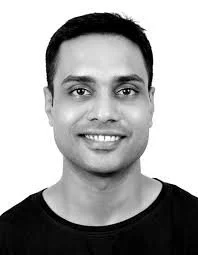
Ankush Banerjee is a poet, masculinity studies research scholar, editor at Usawa Literary Review (a Mumbai-based feminist literary magazine), and a serving Naval officer. He is the author of two volumes of poetry, the most recent being, Field Notes on Kindness, published in October 2025. His work appears or is forthcoming in The New Indian Express, The Hindu, Scroll, Collateral, Out of Print, TBLM, and anthologies, Yearbook of Indian Poetry (2020, 21, 22, 23, 24), Best Asian Poetry 2021, and Converse: Contemporary English Poetry by Indians (2022). He has read his work at Poetry by Prakriti, the Delhi Poetry Festival, and Anantha by Samyukta Poetry. He has also been a three-time recipient of the United Services Institution Gold Medal Essay Prize (2015, 2017, 2021), 2019 All India Poetry Prize, and Eclectica’s Spotlight Author in Jul/Aug 2022, for his poem, Feet of Women I Know. He is currently based in New Delhi.
