
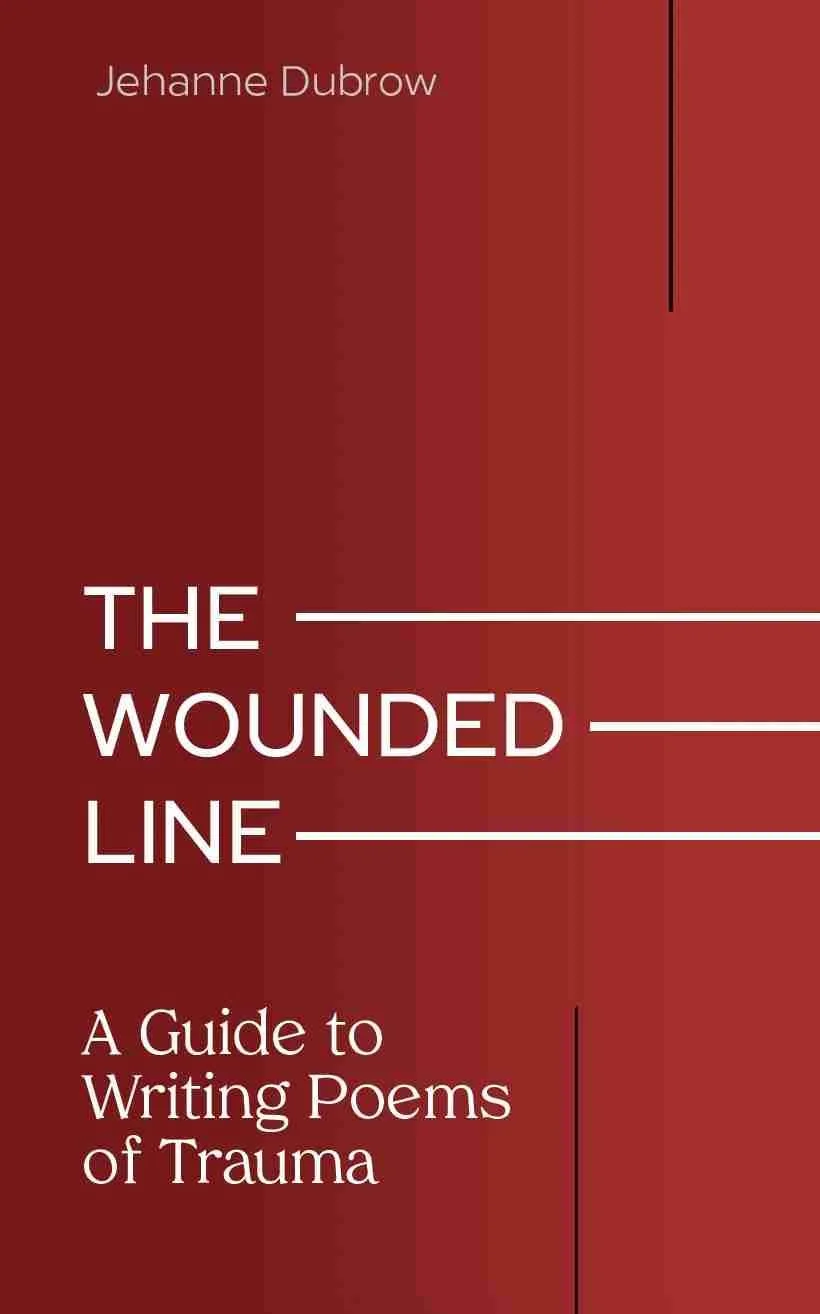
REVIEW OF JEHANNE DUBROW’S THE WOUNDED LINE: A GUIDE TO WRITING POEMS OF TRAUMA
by Randy “Sherpa” Brown
In “The Wounded Line: A Guide to Writing Poems of Trauma”—a 144-page collection of 20 energetic, digestible essays on poetic forms and functions—poet, essayist, and professor of creative writing Jehanne Dubrow invites readers to engage more intentionally with a larger community and continuity of trauma-centered artists. She carefully unlocks insights and techniques for poets engaging in themes regarding violence, abuse, and death. She also ends with a few cautions regarding the costs of trauma-work itself.
Despite the hard and serious themes at hand, Dubrow’s tone is consistently welcoming and collegial—this book doesn’t deliver a lecture, but rather presents as a warm conversation with a well-read friend. Dubrow’s objective is not to define what is and isn’t trauma, but to provide readers literary and scholarly examples from which to grow in new directions. One imagines Dubrow plucking texts off her own office bookshelves, handing them off to her fellow poets in breezy and enthusiastic curation. Did you see how the poet did that? Have you considered this form or topic? As Dubrow writes, “We can build a personal canon of texts that inspire us aesthetically and ethically. We can read across genre and discipline. We can ask ourselves the difficult, discomfiting questions.”
Building on the momentum, Dubrow delivers a handful of writing prompts at the close of each chapter—each prompt helpfully grounded in the poems and citations provided in the text. Each entry delivers just enough intellectual grit to provide readers traction and inspiration. It is easy to see the connection between page and practice.
Dubrow is a professor of creative writing at the University of North Texas, and author of more than 10 poetry and essay collections. Writers in the “veterans-lit” and war-writing ecospheres will recognize her trilogy of poetry collections written from the perspective of a U.S. Navy spouse written during decades of military life and war: “Stateside” (2010), “Dots and Dashes” (2017), and “Civilians” (2025). The daughter of two American diplomats, Dubrow often also publishes in the contexts of intergenerational trauma and the Holocaust, and the intersections of power, cruelty, and authoritarianism.
Dubrow’s 20 essays cover a spectrum of forms and functions, cleaved into two categories. In the first half of “The Wounded Line,” essays with headers such as “surrealisms” and “list poems” and “non-linearities” illuminate methods of representing the traumatized mind. The approach delivers both practical techniques and wise insights. The chapter on writing inspired by visual artworks, for example, Dubrow notes that “because ekphrastic poems start with descriptive passages before transforming into encounters with the self, they are particularly useful for writing about trauma.” She also notes that ekphrasis is also particularly useful in generating ars poetica—poems about the writing of poetry. Each observation seems a classroom-ready insight, charmingly delivered as off-handed wisdom.
In second half of the book, Dubrow’s essays offer rhetorical tools and concepts to facilitate readers’ explorations, communications, and navigations of traumatic events. Using terminology borrowed from historian of intellectual history Dominick LaCapra, Dubrow writes: “Writing any poem is difficult. Sometimes writing poems about pain can seem almost impossible. Much of the first half this book provides techniques for writing poems that represent the experience of being inside the traumatized mind. And many of the later chapters offer rhetorical strategies that poets can use to make arguments about the nature of trauma itself. [...] This is a book both of acting-out and of working through.”
In winding down “The Wounded Line,” Dubrow’s conversational voice takes on a confidential air. Having provided practical tips and inspirations, she gently reminds her fellow poets to practice self-care, and that self-care means different things to different poets. More generally, poetry about trauma will come only when the moment is right, and the moment may not be right until time has granted a little time, perspective, or healing. “I’ve learned that, while trauma is a wound, ideally the writing of the poem comes after the post-traumatic,” Dubrow writes. “The poem should be composed once the wound is scabbed over, if not fully healed.”
Ever the poet herself, Dubrow reminds her fellow writers of trauma to occasionally re-ground themselves in beauty and delight. To illustrate, she shares one sublime moment: “During the most difficult moments of drafting this book, I would look up from my computer screen and remember the cup of black tea cooling on the kitchen countertop. There it was—the mug waiting for me, a pale wraith of steam rising from its surface. Already I could imagine the taste of a gingersnap cookie dipped in the dark liquid, the tannin and spice, the sharp crumbs like sand dissolving in sugar on my tongue.”
Whether a poet is navigating through their practice a personal path of healing; documenting a multi-generational history of displacement, addiction, or abuse; or providing witness to current events, Dubrow’s “The Wounded Line” will likely prove a trusted companion on the journey. It offers poets of all abilities a handy but not-too-technical reference, an evergreen touchstone of inspirations, and a key to placing oneself within a larger community of trauma-writing practice. In short, Dubrow’s sharp and sugared words create welcome context, space, and perspective for all those willing to take on the world. Highly recommended for poets of all abilities and interests.
Randy “Sherpa” Brown is author of the award-winning 2015 poetry collection Welcome to FOB Haiku: War Poems from Inside the Wire. A 20-year retired Iowa Army National Guard veteran with one overseas deployment, he embedded with his former unit as civilian media in Afghanistan, May-June 2011. Among other titles, he co-edited the 2023 anthology Things We Carry Still: Poems & Micro-Stories about Military Gear. Visit: linktr.ee/randysherpabrown