Protest
Wish I could remember the names of birds.
It may have been a warbler,
that pretty gold flecked wingspan
stalled in my mind.
A group of us are riding a bus from D.C.
We are on our way back home to Minnesota.
We have said all the things; they bombed Gaza anyway.
We will march again and tomorrow
that will still not be enough to save anyone
not even the babies,
but we must believe in a ceasefire.
I mean, the snow is melting
across the bus’s window
like stretch marks upon the glass,
while every curvature of middle-America’s heartland
goes on without noticing.
We reach for a ceasefire
and tell our bodies to catch up
We reach for an end to occupation.
We tell our minds to shut up about the warblers,
which could not survive our winters
though they depend upon our springs.
I want to scream. Instead I cry.
In 2023, during early iterations of the ongoing genocide in Palestine, as a poet, it felt necessary to organize with and alongside Palestinians who, in addition to responding to the genocide and occupation of Palestine were having to push back against Western media’s dehumanization of them. I spent the majority of my time trying to do any and all things in my local community to push back: protests, fundraisers, direct actions, city, state, and national campaigns. In all of this it felt wrong as a non-Palestinian poet to write poems ‘about’ genocide. It felt ‘right’ to amplify the works of Palestinians, especially Gazans. So I did that, whenever I was invited to recite poetry publicly. However, when Mosab Abu Toha wrote a post on his social media calling poets in solidarity to write poems for Palestine, ‘Protest’ was one of the first poems I wrote in response to his call. I realized I could utilize my small platform as a poet to facilitate narrative changes that directly challenged the disinformation being spoon-fed to the general public, so I pivoted to writing and publicly reciting ‘protest poems’ that countered the dehumanization in a way that I hoped resonated with people who knew little to nothing about Palestinians. I submitted these poems to journals knowing they would be rejected but hoping that submission readers would still contend with their message. —Sagirah Shahid
Elsewhere,
He glances at my bottom lip when he says he loves the color mauve.
I watch him pack his silver laptop into his mauve backpack and wait for him
to ask me the question we have both been waiting for the other to ask.
Elsewhere,
the mauve tendons of a severed wrist, alabaster bone
and the pendulum swing of a string of darkened skin
slow to abandon the arm it once belonged to, I have
never seen a severed hand before this,
Dear Gaza,
Elsewhere,
he is all disheveled dark hair and a sleepless night. I can’t tell if we are
friends because of the war or if we are friends because we want to fall in love.
It is not a war. We are not the kinds of Americans that watch the news and believe it.
We know a lie when it comes for our throats. Which headlines want to slaughter us, again,
he is all disheveled dark hair and a breathless night.
Dear Gaza,
Elsewhere,
a dark-skinned girl of 9 years old doesn’t have time to grow-up,
so she documents the devastation, destruction, dreams, desires,
death, devoting herself to discovery. She is beautiful. Darling little
journalist—doesn’t she look like our daughter, if we made daughters
together? Dearest, darling child, don’t die. Doesn’t my needy heart
depend on you to live? To survive this renewed catastrophe? Don’t die.
This is not a conflict. It is not a war when more than half the population
are children. And the other half? The fathers, the mothers, the siblings,
the cousins, the grandparents, the aunts and uncles, the neighbors mourning
those children, if they survive.
Dear Gaza,
Elsewhere,
He asks me if he can get a hug before he leaves. And I want it to last forever
but I hasten it, the hug I mean. Because I’m afraid he’ll notice how much
I needed it too. I can’t tell if our bodies want to fall in love, because everything about this country is trying to kill us, has tried to kill us. Palestinian-American man, African-American woman. Muslims. We hug and let the prisoners of our lungs run away with our unspoken griefs, our grievances, our rage.
Dear Gaza,
I see the severed hand in my dreams.
I search for the little girl’s instagram posts each night.
Don’t die. It is not called death when whole generations,
when human beings are being slaughtered
in the thousands,
don’t die.
Dear Gaza,
Dear Gaza, Dear Gaza,
Dear,
Similar to the poem ‘Protest’, I wrote ‘Elsewhere’ as a response to Mosab Abu Toha’s call to action directed at poets. ‘Elsewhere’ is very much attempting to push back against the narrative dehumanization that was prominent at the time, especially concerning Palestinian men. It is also attempting to consider the impacts of genocide on both (at the time) invisibilized Palestinian communities, such as Afro-Palestinians, and also attempting to consider the impacts of the genocide on children and on Palestinians in diaspora. The little girl that is mentioned in this poem is named Lama Jamous. Her courage to report on the genocide as a child, escapes words. Lama is older now and was forced to flee from Gaza a year after I wrote this poem, she is still using her platform to advocate for her people. You should follow her on Instagram (@lama_jamous9) or your social media platform of choice. I do not know the name of the person who had their hand severed in Gaza—and this is my shame as an American, to be of a country that could tolerate genocide. —Sagirah Shahid
Silence
In remembrance of Ahmed Al-Najjar, 18 months
There
There was
There was a head
There was a headless
There was a headless baby
LOOK
at the headless baby
LOOK
attheheadlessbabylookattheheadlesbabylookattheheadlessbabylookattheheadlessbaby
LOOK
At the head
Less
Baby
A baby’s head
Look
Less
At the headless baby
There was a baby
Held up by his father
Look
At the newspapers saying nothing
Look
at the president doing nothing
Look
At you
Now that you have seen
an actual,
headless baby
This poem I wrote in rage. In heartbreak and in horror. Again, like ‘Protest’ and ‘Elsewhere’ this poem was an attempt to challenge the dehumanization of Palestinians and to hold Western media accountable for what has been allowed. I struggle to find the right words to talk about this poem, so I just want to repeat Ahmed Al-Najjar’s name so that anyone reading this knows his name and continues to take actions to end both the genocide and occupation of Palestine. —Sagirah Shahid
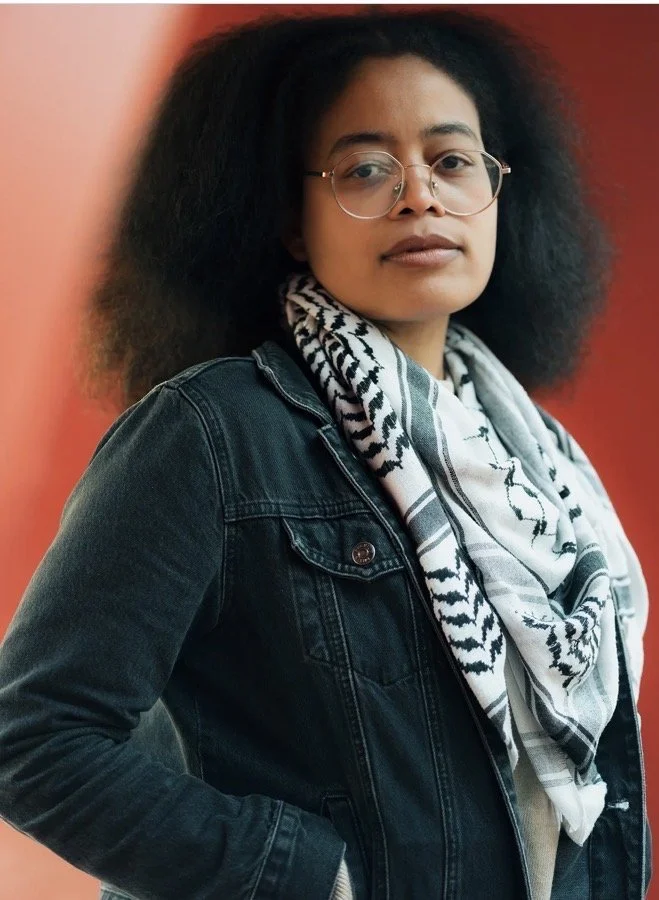
Sagirah Shahid is a Black American Muslim poet and performance artist from Minneapolis, Mni Sóta Makóče. In 2015 Sagirah received a Loft Literary Center Mentor Series Award in poetry, a Minnesota Center for Book Arts Mentorship award in 2016, and received a performance arts and storytelling fellowship from the Twin Cities Media Alliance in 2018. In 2020, Sagirah was one of 23 artists selected by Muslim Advocates and the Shangri La Museum of Islamic Art, Culture & Design to be featured in the American Muslim Futures virtual exhibit. Sagirah is a member of the Mizna writing collective and is a former poetry editor of Overtly Lit journal. Her debut poetry collection is forthcoming from Lightscatter Press in spring 2027.