
Olga Tikhonova
The Daily Routine of the Apocalypse
This story is inspired by a real life interview. All names and identifying details have been changed with the participant’s consent.
*
I switch on the electric kettle and for some time just listen to its comforting purr. I’ve just returned from work. I am tired and cold and I am dying for a huge cup of hot fragrant tea.
Thoughtfully, I rest my head on my hand and look at familiar but meaningful objects around me.
My husband and I bought this apartment in the town of Bucha near Kyiv in 2019, two and a half years ago. Since then, we’ve been continuously turning it into the most comfortable place on earth. We are both visually impaired. During our lives, both of us have had experience living in all kinds of places, including boarding schools; maybe that’s why our house is so important to both of us. Everything matters here: the beige wallpaper that somehow makes the room warmer, my sunny-yellow kitchen cupboards, light curtains on the windows, and my favourite tablecloth with a traditional periwinkle pattern. Souvenirs from our travels are everywhere: Polish amber and Ukrainian wooden painted plates. An entire shelf is filled with our photo albums. The chipped desk where I usually work is old and has moved with us from one apartment to the next, but I don’t want to give it up. While I work, my fingers run over its familiar scratches. Potted violets on the windowsills and on top of the cabinets are a particular source of pride for me. I enjoy making things grow, caring for living things, and I think my whole apartment is alive, in a way.
The presenter on the TV explains that martial law has been introduced in the country. Fleetingly, I remember that on my way home, I didn’t stop to buy water. But I chase this thought away. It’s not like the war will really start tomorrow.
*
I strike a match and light the stove. I put the kettle on the burner. We are so lucky to have a gas stove and not an electric one. As for the matches, I didn’t think to buy them last time we went shopping. It was on the morning of February the twenty-fourth. Everything had already started. But we had no idea of what we were supposed to do. We just picked some random goods, that’s all. We still didn’t believe it then, we kept waiting for it to end. But no, this nightmare is going on.
Strange, in the morning of the twenty-fourth we still didn’t hear explosions, but in the afternoon already I could see from my balcony black smoke coming from the town of Hostomel. And the sounds of explosions were also heard here in Bucha. In the morning I was, as usual, woken by my alarm-clock. I got up, got dressed, gave Rysya some cat food and made coffee for myself. Only then I switched on the TV and learned…
The water in the kettle boils. The fire warms the kitchen a little. It’s been days that we haven’t had the heating. The temperature in the apartment is thirteen degrees Celsius. I imagine that in the basement where we spend the nights it must be even colder. Obviously, we sleep dressed, inside sleeping bags. In the basement there are small pantries made for each apartment. The building was constructed not long ago, some apartments haven’t been sold yet, so those pantries stand open. That’s where we sleep. A capsule hotel, as our neighbours joke. Of course, Rysya also spends the nights there with us. Some people leave their pets in the apartments, but I can’t. In the basement, we put a special harness on her. I wrap the leash around my wrist. By now I am a little used to it, but during the first night I kept waking up and checking if our cat was still there. There was another night when our Rysya started purring really loudly. “You poor thing, I thought, whom are you trying to comfort, yourself or us?”
I make tea and pour it into the thermos.
Rysya jumps from the window to the floor, comes to me and starts to rub against my legs. I pick her up, a warm fluffy ball. We adopted her in a shelter. Back then I thought I was able to offer at least one single creature a long happy life full of love and care. Now I am not so sure.
Still holding the cat, I walk from the kitchen into the room and glance at our packed things—two backpacks and Rysya’s carrier with cat food inside. Yes, everything seems to be ready in case of another air raid. Now it seems ridiculous, how careless we used to be just a few days ago. It reminds me of a friend who has moved here from the Donbas region. She’d kept a ready bag with all the important stuff. We knew about it but never related it to ourselves. She used to say that in 2014, when the invasion started in the Donbas region, she hadn’t been prepared either. Now we have learned this lesson as well.
We don’t leave our residential compound anymore. It’s just too scary. We’ve hardly got any mobile signal or the internet, so we don’t even always know what’s happening in our town, who is here now—our troops or the enemy.
Yesterday, the twenty-seventh, was probably the most terrifying day so far. Not far from our house, in Vokzalna street, there was fighting throughout the day. Together with our neighbours we were hiding in the basement. The power was out. It was dark and cold. Some people switched on flashlights. Somebody’s cats meowed, somebody’s dogs barked. And every few minutes the building shook with explosions. We talked about something meaningless, discussed our pets and kept listening to the battle sounds, trying to understand what was happening. We all realized that our basement was a bad shelter. Should the building collapse, it would bury us under.
But we are still alive.
It’s strange how quickly the human mind accepts new game rules. What just yesterday seemed impossible, today has become our reality. We’ve accepted it all— the absence of electricity, heating, the internet and mobile connection, constant sounds of shooting and explosions, the realization that there is a great chance at any second our lives can end.
Last night, after the battle, lots of people whose houses in Vokzalna street had been destroyed came to our residential compound. Our neighbours worked together, made lists of who is here and who isn’t, who needs help. And I was given matches, which I had so carelessly failed to buy when I still could do it.
It didn’t take my husband and me long to take the decision to go. As I see it, people with disabilities stand no chance of surviving in the situation of an apocalypse. We’ve been lucky so far. We have enough food. We have gas so we can boil water for tea and even cook something. We live on the first floor, so there is often some water in the taps, even though it’s not drinkable. But we won’t be able to walk several kilometers to get water from a pump with explosions all around us. We won’t be able to cut a tree and build a fire and cook a meal on it. And I have no doubt that this is exactly what awaits us all here.
During my life I’ve put a lot of effort into becoming as independent from the help of others as possible. Luckily, today’s society offers a lot of convenient tools to achieve this. Say I don’t know how to get somewhere; I can use the GPS. If, for some reason, I can’t get to some place, I call a taxi. If I can’t find some rare product in a supermarket, I will order it online. All this helps me to compensate for my poor sight. But since the beginning of the full-scale invasion all these independence skills have become useless. Now I fully depend on the help of others. The way I perceive it, war is about helplessness and dependence.
And so, no matter how hard it is for us to leave home, we’ve had no doubt that it’s the right thing to do.
On the second morning, after a night spent in the basement, we watched some families pack their luggage and get into cars, ready to go. We’d come up to them and ask if they had some room in the car for us. But there was no room anywhere. And so, one after another, the cars left the parking lot and we remained feeling helpless. As if everyone else was about to save themselves.
On the same day we started calling different taxi services. In Bucha not a single one was functioning. In the neighbouring town of Vorzel, they’d answer the phone but said they wouldn’t go to Bucha. In Kyiv, as soon as they heard the name Bucha, they hung up.
Then we tried different chats, but the answer was the same everywhere: “You are from Bucha—sorry, we can’t help.”
We considered going on foot. The plan was to get to the supermarket in the town of Stoyanka. We knew of a carrier who picked people up from there and took them to the Western Ukraine. The distance from our place to that supermarket was about fifteen kilometers. In the times of peace, it was just a normal two-hour walk, but now it was totally different. We kept hesitating and decided against it in the end. What if this minibus doesn’t come, for some reason? What shall we do then, right in the middle of a highway? And besides, in the time of peace, my husband and I could easily rely on our remaining sight to feel confident outside. And now? I won’t even distinguish a Ukrainian soldier from a Russian one. And what if I step on explosives just because I won’t be able to see what it is on the ground?
*
On Tuesday in Bucha there’s a bit of calm. They say the Russian troops have retreated. In the morning, we return to the apartment from the basement.
I go to the kitchen, give Rysya some cat food, make some tea and pour it into the thermos. Normally, I am addicted to coffee. But we haven’t been drinking it since the beginning of the war. The only thing we’ve got is beans which we can’t grind without electricity.
Then, while it is calm, I decide to heat some water and wash my hair. Maybe this side effect of what we’ve been going through is not the most evident one, but it turns out that, if you live from one air raid to another, and from one escape to the basement to the next, suddenly enjoying a nice bath is out of the question. So, giving my long hair a decent wash is now the stuff of my dreams.
When I get out of the bathroom, a towel wrapped around my head, my husband tells me that today a supermarket near our compound has started working. I am shocked. This is a priceless opportunity to replenish our food stock, and I have no idea when we’ll get another one like this. But I have wet hair, and outside it is freezing. Getting sick now is not something I can afford. I refuse to let my husband go alone as well. There is no mobile signal. Anything could happen. It seems, as soon as one of us steps out the door alone, he will disappear without a trace. And so, I walk around the apartment in a winter jacket and with a towel on my head. Because in the apartment it is so terribly cold, my hair won’t get dry. Finally, at two there comes a message that the supermarket has closed again.
In the afternoon the electricity comes on and I can dry my hair with a hairdryer. But by then we’ve got nowhere to go shopping to.
*
The town council asks not to overuse the electricity, not to switch everything on at the same time. Of course, at the smallest opportunity, people want to wash and to vacuum, but the power grid can’t cope.
When the mobile signal comes, we start calling everyone we know just to make sure they are alive, that they are not harmed, to find out if they need any help, even if right now there is little we can do, but at the very least, we can offer moral support.
Among others, we call Andrew. He is my husband’s colleague. He and his wife live in Irpin, not very far from us by the standards of the peace time, and by the present day standards, beyond any reach.
Having learned that we remain in Bucha, they get anxious, promise to try to do something for us.
They call us back later to tell us that they’ve tried to get to us on foot but were not allowed to pass.
And yet again our attempt to get out fails.
*
On Wednesday, the calm continues.
Looking back at the last week, I realize that in my mind these days are made of small routine tasks: get dressed, give some food to the cat, make some kind of breakfast for us too, eat it. What have I been thinking of these days? Have I been scared? No. First we were waiting for it to finish. Then there were our attempts to get out. But there was no fear. Just this weird daily routine which is now our whole existence.
On Wednesday night, when it’s already dark, all of a sudden, Andrew calls again.
“What’s your address? I am already in Bucha. Got in through some back alleys. But it turns out it’s curfew now. I am retained by the police.”
And just like this, accompanied by the police, he comes to us. Him standing in our doorway is the least believable thing I have ever seen.
Once they’ve checked that he’d been telling the truth and someone is really waiting for him at this address, the officers leave. But we can’t get going right away. We have to wait till morning and the end of the curfew. Andrew calls his wife to let her know he’s arrived safely. We go to the kitchen, catch up on the news. Then it’s time to pack for the trip and it turns out it’s the hardest thing for me to do during this whole time. My home, which I have been building up like a mosaic, one thing after another. Everything here is full of meaning for me. How do I leave it all? What do I take?
In reality, we can only take two backpacks and Rysya’s carrier because we’ll have to walk and it’s anyone’s guess what can happen to us during this journey. And not so much can be squeezed into the backpacks—just what’s necessary, nothing fancy. Some spare clothes, our laptops, some canned food. As for the rest of our things, I only pick them up for a second to say good-bye and put them back in their places. Here’s my favourite cup. And this one is my husband’s favourite. Our photo albums. I won’t be taking them either. The worst thing is that at that moment I forget about our vyshivankas, traditional Ukrainian shirts with special embroidered designs. My husband and I gave them to each other as presents, we ordered them handmade, chose the patterns for the embroidery. This is probably the most memorable thing we’ve got. But at that moment, stunned as I am, it doesn’t occur to me to take them, though for them I would be sure to find room in our backpacks. But they remain hanging in our closet.
Finally, everything is packed. Dawn comes. We pick up our luggage and leave our home, not knowing whether we’ll ever return here again.
*
And so we walk. Through our town. Through morning quiet Bucha. The silence is really unnatural. It’s probably high time to get scared. But I just keep turning in my head whether I’ve taken everything we need, if I have switched off and closed everything at home. Inside of me it’s as empty as in the streets around. There is not a single car on the roads. But we, out of habit, I suppose, walk only on the sidewalks and cross at pedestrian crossings. There are no pedestrians either, but we come across several dead bodies. Luckily for me, I can’t see any details, but Andrew tells us they are the enemy.
We arrive at Vokzalna street. Here, after the fighting on Sunday, it’s the picture of an apocalypse. Destroyed armoured vehicles. So many ruined buildings. Looking at an apartment block which was hit by a shell, I think it’s likely our house might look like this soon. I simply note all the horror around us. One day I will allow myself the weakness of living through it all again and feeling both fear, and bitterness, despair and pain. But right now we have to hurry. We just have to survive.
Andrew’s presence really helps us during this journey. Not only in the most evident way. He keeps describing to us everything that is around and with some optimistic comments manages to make even the scariest things seem not so terrible.
When we reach a checkpoint, they retain us. It turns out the curfew hasn’t finished. It will last till eight.
The military men at the checkpoint start questioning us: where we are going, where from. They want us to stay with them till the end of the curfew.
And so we wait. Then, all of a sudden, somewhere far, there starts a roar which is getting closer and louder by the second. Planes.
“Where can we hide?” we yell, horrified.
But the military men only shrug.
“Stay here. Here by this fence. And if you believe in God, now is a good time for praying.”
The planes are already here. We have no choice. We cling to this fence as if it can protect us.
They say at such moments your whole life passes in front of your eyes. But nothing like this happens to me. I am still not even scared. The only thing I feel is an adrenaline rush. Later I will understand how close we were to dying at this moment. After all, we were standing at a checkpoint. There were Ukrainian armoured vehicles there. Logically, it should have made an attractive target. I guess we were saved by the fact that the Ruscists are seldom guided by logic in their actions. In any case, they dropped the bombs on the apartment blocks and we survived.
I remember what comes next in flashes. The thunder of an explosion. We are alive. Another bomb. Still alive. Another one.
I imagine it must have been harder for Andrew’s wife who was waiting for us at her home in Irpin. I can’t start to fathom what it must have been like for her.
Finally, we can continue our way.
Travelling in Irpin is slightly easier and soon we have arrived.
But we don’t have a plan for what to do next. We discuss the possibility of staying here at Andrew’s but then we take a decision to keep travelling all together. We agree that the best thing for us to do is to try to get into Kyiv and from there take a train to Lutsk, where my husband’s parents live. But we have no clue how to get to Kyiv. We are trying to find some information but there are no organized sources. It’s known that all the bridges leading to Kyiv have been blown up. Finding out something about the state of roads is only possible through the grapevine, through friends of friends, on different forums.
Getting a taxi in Irpin proves to be impossible too. But we do manage to order a taxi to Kyiv from the neighbouring village of Romanovka. However, the price of the trip, which during the times of peace would have been around 300 hrivnas, now is 3000. But we are not judging. After all, the driver is really about to put his life at some serious risk. We understand that not everyone is ready to do it out of altruistic reasons. And the war is a time when people’s true natures are revealed. We’ve already learned this. As for the trip, we would pay for it much more. The only thing that counts for us is getting away from here.
We walk to Romanovka.
We reach the bridge. Or rather, the place where it used to be.
At the place of crossing people have put across the river a couple of metal pipes and use them to walk to the other side.
I glance at Andrew and his wife and am flooded with gratitude for their being here with us at this moment. I pass the carrier with Rysya to them. Myself I wouldn’t risk crossing with her. It’s the only thing I worry about, for them to help us with the cat. As for ourselves, we’ll cross somehow.
*
After that things get better. We get into the car and we are in Kyiv. We go to the train station. While still in the taxi, we manage to learn about an organization that transfers Belarussians from the railway station in Kyiv to Lviv by buses. They are prepared to take others on the remaining places. We inquire about the cost of such a trip, but they won’t even hear anything about money. And so, we’ve travelled from Romanovka to neighbouring Kyiv for three thousand and will go From Kyiv to Lviv, across the half of Ukraine, for free.
I am exhausted. We hardly slept last night. We’ve been on feet and under constant stress since seven AM. Finally, seated in the warmth of the bus, I immediately fall asleep.
*
In Lviv a totally different reality awaits us. Here there is heating and electricity. At the station and in the city there are so many people! All this makes us feel a little disoriented.
*
We spend several weeks that follow at my husband’s relatives’ in the West of Ukraine. On the one hand, for us it’s a chance to relax a little. On the other hand, we are afraid to stay here long because of the risk of invasion from the Belarussian border. We can’t afford to be taken unawares again. Besides, every minute we keep track of the news coming from Bucha. And so far, it has only been bad. Then, starting from the twelfth of March, it stops coming at all. And it’s the worst.
I am anxious. The constant worry about our house is added to the general horror of what’s happening. Does our home still exist? There is no way for us to find this out.
*
Finally, Bucha is liberated. Terrible images and first reports start coming from our town. Bodies in the streets. We watch, we listen and we can’t believe it. The whole world is holding their breath and for us it’s the place we live in. And one more thing. It’s only now that I can fully comprehend the meaning of what Andrew did for us when, risking his own life as he led us out of Bucha. Yes, to be sure, even that day I was already incredibly grateful to him, but at that point I still didn’t know enough about the war. And now that I’ve seen what was going on in Bucha during the occupation, I realize that we would definitely have died. Andrew, an ordinary man, who had never even been our close friend, saved our lives. I think that I’ll never be able to thank him and also, that the world must still stand due to people like him, those who care.
When we get the first images from our residential compound, I can’t get enough of looking at them. I keep enlarging them on the screen, trying to see as many details as possible. Is my building intact? Broken windows and walls darkened with shelling don’t count. My heart leaps with joy when I recognize our courtyard, find our entrance. But there are so many things that shouldn’t be there. In one building part of a wall is missing. Bags of sand are everywhere. Twisted metal is scattered across the playground. The café where I celebrated my birthday was hit by shelling and is destroyed. All this looks surreal. This is my home, the place I left not so long ago.
*
After the eighth of April, they start to let civilians enter Bucha. Some of our neighbours return there. In our apartment they board up the broken windows and put the door back on its place. Rather, just lean it in the door frame because our door was forced, just like any other door in our building. Not a single one has remained intact. We had the original door from the building company, but some people replaced theirs, putting in armoured doors. So in those apartments, where they couldn’t just break down the door, they blew up a part of the wall, with a grenade or something, to then be able to open the lock from the inside.
We discuss the possibility of going back. There are lots of cases when people return and simply get blown up by a trip wire in their homes. That’s why we, both with poor sight, are afraid to go alone. We make arrangements with a relative and on the fourteenth of April go home for the first time.
And so, we are at home. Here the invaders lived for several weeks. They slept in our bed with their shoes on. They ate from our plates. They went through our things.
I am already mentally prepared for what I am about to find. We are not the first ones. We are not alone in this.
In our apartment it’s the picture of a total destruction. Broken glass everywhere. Our things in piles are thrown on the floor. The flowerpots are overturned, the soil from them spilled on the floor. Even our cacti didn’t survive the occupation. Photo albums are thrown around. Photos are torn and thrown on the floor. They were stepped on. But what’s most important, our vyshyvankas aren’t destroyed! I can’t believe this luck.
How do I describe the feeling of disgust from knowing that these creatures went through our things, touched them with their hands?
We get down to cleaning. During our first visit we only manage to take out several garbage bags with trash and broken glass.
We are lucky. Not that much was stolen from us. Bigger appliances, such as the washing machine and the dishwasher, remain and, what’s more, aren’t broken. In other apartments they crashed what they couldn’t take. They threw knives at TV-sets and had other fun like this. From our place they didn’t take all that much: an old computer, a robot vacuum cleaner, a printer and paper for it. Our friends joke that they took the paper to write killed-in-action notices on. Well, if that’s so, I don’t mind. Also, I had an electric toothbrush. I didn’t take it when we were leaving. It was too heavy. So they stole it. They found the spare heads for it as well. Were smart enough for that. As for the epilator, it turned out to be a little tougher for them. They took the spare heads, but left the device itself and the charger. So I can’t use it, and neither can they.
In our apartment there were lots of other people’s things as well. There was a suitcase, still empty, ready for packing. The occupants were leaving in a hurry, didn’t have time to take much.
The residents of our building create a special chat to look for the owners of things they find in their homes. Someone has discovered around thirty mobile phones, others a pile of jewelry, laptops.
By June, electricity and water supply are restored in Bucha. We return there to stay on the twentieth of June. Before that we come about once a week to clean. If we have thoughts about going to another country, they are fleeting. My husband and I agree that we won’t be able to live elsewhere.
Having returned, we do minor repairs in the apartment. Because of the explosions there are cracks in the plaster, the wallpaper is peeling off in some places.
First, we expect the government to finance the windows replacement because there is some information that this will be done. But we get tired of waiting and replace the windows ourselves.
Our building was hit several times. Some apartments are completely destroyed.
Life goes on. Though, even now, sometimes during the residents’ discussions on absolutely unrelated topics, you might hear: “Don’t you tell me what’s right. You weren’t here during the occupation.”
*
The following winter is difficult in its own way, when there is no electricity. We try to return home by four and not to go out again in the evening. The city is completely dark and generators roar everywhere. So we can’t rely either on the remaining sight or on hearing. And at home it’s cold and dark. No internet or mobile connection once again. And all we hear are explosions somewhere in the distance. But we are at home. For me it means a lot.
We don’t know what is waiting for us. We don’t know how much longer the war will go on and how it will end. We live in the present, enjoying the small moments of happiness, the purring of our cat, so loud that we have to turn up the volume of the TV. Our beloveds are near.
The snow has fallen. It’s gorgeous. The New year has come. And now the snow has melted. It’s spring. Another year of war. And we continue to love. And continue to hope. And the electric kettle switches on. I make tea. And the thermos is now always prepared. And Rysya’s carrier always stands on a little table. And before going to sleep we turn off our laptops and pack them in our backpacks. We are always prepared for the worst. But we are at home, we are together, and it’s the only thing that counts.
“In 2023, having immigrated to Poland with my family and having written our experience down as a story, I started a project the goal of which was to collect the experiences of people with disabilities during the war in Ukraine, hoping to give them a voice. ‘The Daily Routine of the Apocalypse’ is one of the stories I collected. It was told to me by a person I knew from school.” —Olga Tikhonova
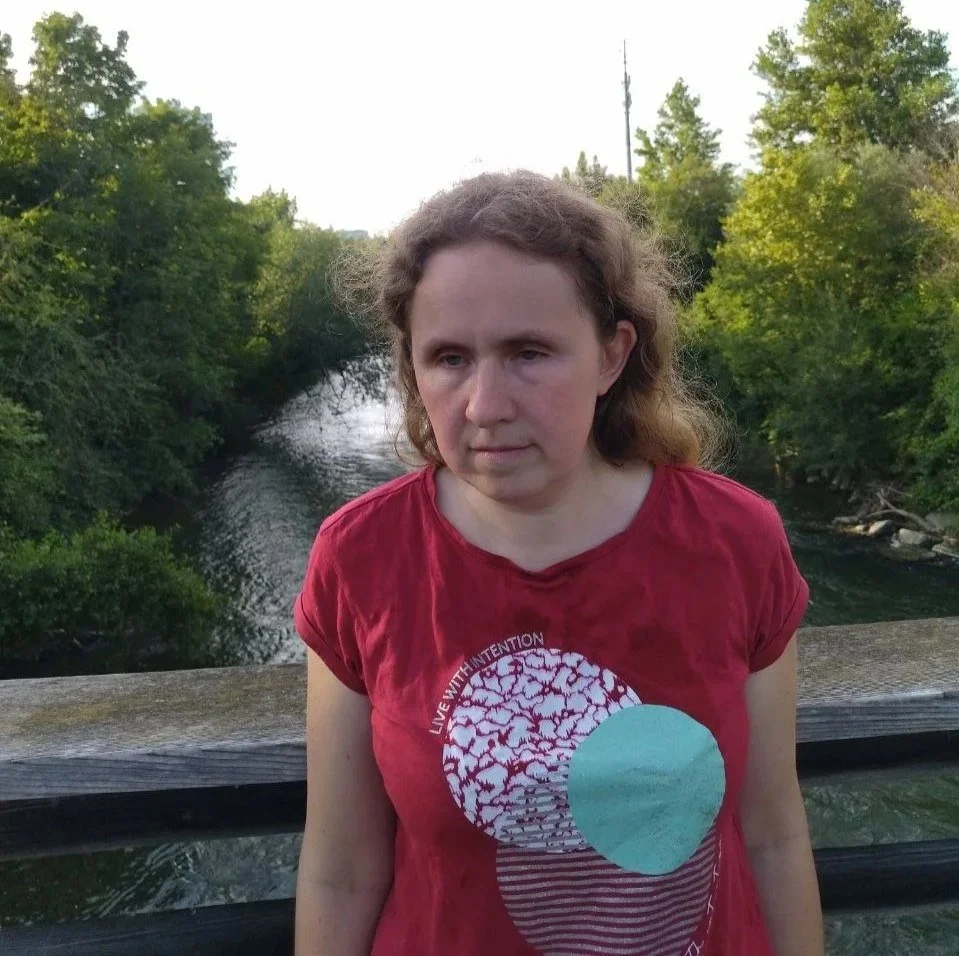
Olga Tikhonova was born and raised in Ukraine and now lives in Poland due to the war. She holds a degree in English and French, speaks six languages, and works as a private language tutor. She is blind. Her poetry and prose have appeared in regional literary publications, and in 2005 she was accepted into the Union of Ukrainian Writers. She has published four poetry collections and a book of short stories in Russian.
