
Kristen Keckler
Jungle Flower
Free Design reads the sign in the window, no shop name above the door. It’s the kind of low-key strip mall nail salon you find often in a sprawling city like Dallas, wedged between a burrito take-away and KFC. No appointment necessary, run by a Vietnamese couple and their sisters.
“Pick a color!” they say on cue, and I wave my bottle like a bell. A grad student on a budget, I bring my own so I can touch up chips between visits. From the plastic chair where I sit, I meditate on the counter shrine, a waving-paw cat figurine among candles and incense cones. Taped to the wall by the register, a display of hot checks ward off potential thieves.
I’m assigned to Hao, today, who starts filling the tub below the pleather massage chair. On my first visit, as his wife finished my pedi, she asked, “You want design?”
“The design is free?” I replied, dumbly.
“Yeah, free! How ’bout a flower?” And she painted a dainty white daisy on my crimson big toe, punctuated with a rhinestone stigma. It looked pretty.
Beside me now, their niece, Vicki, a sweet twenty-year-old, scrubs a woman’s pale, veiny foot.
“Hey, you’re back! How’s school?” I ask. Vicki attends college in Austin.
“I love it, thanks,” she says. “They put me to work when I come home, but I don’t mind,” she laughs.
On the bulky TV strapped to a mount near the ceiling, Dr. Phil preaches tough love to meth addicts and their families. Usually, what you get in a nail salon is half a story—snippets of gossip, drips of news. The woman two chairs over yaps into her cell, “She better keep her skank-ass away from him, or I ain’t paying his bond next time.” As you shouldn’t, I think.
Hao attends to my cuticles with the precision of a tailor pulling out a single faulty stitch. A thin man with starbursts of eye wrinkles, he appears to be my dad’s age, mid-fifties, wears a white undershirt with grandpa pants—worn, gray trousers—and black plastic sandals. When he scrubs the bottoms of my feet with a paddle, uncontrollable giggles escape my mouth.
“Tickle?” he asks, and this makes him laugh, too, exposing the gap beside his incisor.
He scrapes a callus with a tool that looks like a hand-held lemon zester. He is among the few who have ever seen my naked soles.
My sister and I both inherited our dad’s high arches, slim feet—she dated a guy who told her she should’ve been a foot model. My toes are not long nor fat, each descending in size proportionally.
Hao’s sister-in-law sits on a stool near the sink, removing plastic wrap from a quart of steaming broth, which she sips from—I catch a whiff of ginger. She says something to Vicki, who answers in English, “I’ll have some later.”
Hao slides on my flip-flops, weaves twisted cotton rope between my toes so the polish won’t smudge. He shakes the bottle, then taps it on his palm.
“Good color,” he says, approvingly—a hue between purple and fuchsia. As Hao coats each nail, buffed smooth as a river stone, with quick, precise strokes, he tells me, “The color is like…jungle flower.” He explains that as a boy, after school, they’d run into the jungle to play and search for this rare flower. If they found one, they’d pick it and take it home to press in a book to dry. With the polish brush clenched between his fingers like a cigarette, he motions the word “press” by moving his hands together. Then, they’d offer it to girls they had crushes on.
“This color remind me of freedom as a boy. Color of love, special flower, special time,” he says, smiling.
My arm hairs prick, as if with static electricity. Hao’s holding my foot like a delicate fruit, and as he releases it, I feel it touch down in the underbrush. The buzz of the motorized nail file fades into insects and the rhythmic thumping of chopper blades. I look up to see my Marine father, piloting a CH-46 Sea Knight. Weightless, I propel myself up through wisps of fog into the cockpit, where I’m sitting shotgun to Dad. His gaze is laser focused on a miles-wide view of dense green hills and patches of muddy earth. The night before, one of his squadron’s helicopters crashed into Ba Na Mountain during a medevac mission. Dad knows it could’ve been him piloting, but as fate would have it, he’s enroute to recover their bodies. Charred limbs, scraps of mangled flesh, dog tags—his brothers reduced to dust and ash among the scattered, metallic debris.
Their remains returned to the earth will germinate vines and ferns and wildflowers into perpetuity.
Something catches in my throat, but Hao is adding the clear topcoat, doesn’t notice. I am sorry for the working-class boys drafted, for the rural schoolboys who picked flowers, for the destruction and displacement of so many lives, the root cause of which I’ve only tried to remember from PBS specials, movies, and textbooks. Somehow, I was there, I want to explain to Hao; my DNA before it was mine, helixing through the cells of my father. When I tell my sister, she’ll get it.
“You like?” Hao asks, rubbing cream into my calves. Behind him, incense smoke curls like an old phantom.
I look down, and my toes have bloomed.
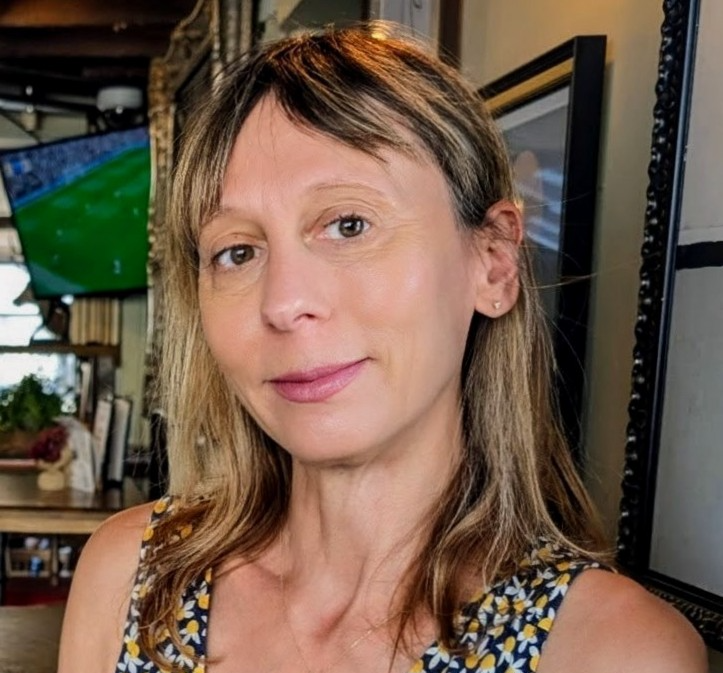
Kristen Keckler teaches creative writing at Mercy University in Dobbs Ferry, New York. Her work has appeared in L’Esprit Literary Review, The Argyle, Sky Island Journal, The Disappointed Housewife, The Collidescope, Does It Have Pockets, and other journals. In her spare time, she plays amateur detective while compulsively listening to cold case podcasts. Kristen’s father served as a Marine pilot in Vietnam (1968–69) in squadron HMM-364, ‘The Purple Foxes.’
